%20Conference%20Logo%20For%20Eventbrite.png)

Conference 2026
Keynote Speakers:
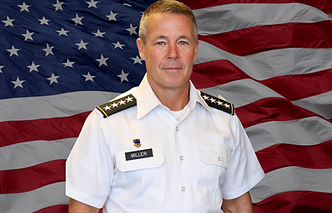
General Austin "Scott" Miller (USA, ret.)
Joint Special Operations Command, Commander, 2016-2018
General Austin "Scott" Miller spent nearly 40 years in uniform, shaping U.S. national security at the highest levels of government. He concluded his career as the final commander of all U.S. and NATO forces in Afghanistan. An Airborne-Ranger and Infantry officer, Miller commanded at every grade, from leading a company in Korea, the TF Ranger assault force in Mogadishu during "Blackhawk Down," and Joint Special Operations Command. His awards and decorations include two Combat Infantryman Badges, two Purple Hearts, the Silver Star, and an extraordinary 20 Overseas Service Bars, denoting more than ten years spent in combat zones.
General Timothy Haugh (USAF, ret.)
19th Director, National Security Agency, 2024-2025
Commander, U.S. Cyber Command, 2024-2025
General (Ret) Timothy D. Haugh served for more than 30 years in the United States Air Force, culminating in his assignment as the 4th Commander, U.S. Cyber Command and 19th Director of the National Security Agency. In these roles, Gen Haugh served as the National Manager for all federal government National Security Systems and led all DoD cyber operations.
A native of Hughesville, Pennsylvania, General Haugh earned his commission in 1991 as a distinguished graduate of the ROTC program at Lehigh University. During his career, General Haugh commanded at the squadron, group, wing, numbered air force, and joint levels. His other notable tours included assignments as Deputy Commander of Joint Task Force Ares, Commander of Cyber National Mission Force, and Commander of Sixteenth Air Force.

Brian Driscoll
Acting Director, Federal Bureau of Investigation, 2025
Brian Driscoll brings more than two decades of senior leadership experience from the Federal Bureau of Investigation and the national security community. Most recently, he served as assistant director/executive lead of the FBI’s Critical Incident Response Group, overseeing the bureau’s special operations and crisis response programs. Prior leadership roles include serving as assistant special agent in charge of the New York Field Office, special agent in charge of the Newark Field Office, and interim director of the FBI.
From 2022 through January 2025, Brian served as the commander of the FBI’s Hostage Rescue Team, leading the FBI’s national tactical operations. He also served as a tactical operator on the Hostage Rescue Team for eight years, earning the FBI Medal of Valor and Shield of Bravery for his actions under fire. He began his FBI career as a special agent in New York, working organized crime investigations and serving on the New York Office SWAT team.
Barbara Leaf
Assistant Secretary of State for Near Eastern Affairs, 2022-2025
U.S. ambassador to the United Arab Emirates, 2015-2018
Ambassador Barbara Leaf served as Assistant Secretary of State for Near Eastern Affairs, developing and implementing policies and programs for 18 countries from Morocco to the Arabian Peninsula. She served as deputy assistant secretary of state for the Arabian Peninsula in the Bureau of Near Eastern Affairs and as deputy assistant secretary of state for Iraq; directed the U.S. Provincial Reconstruction Team in Basrah, Iraq; and served as the department’s first director of the Office of Iranian Affairs. In addition, she had postings in Rome, Sarajevo, Paris, Cairo, Tunis, Jerusalem, and Port-au-Prince.
Ambassador Leaf departed government as a member of the Senior Foreign Service and has received numerous Superior Honor and Meritorious Honor Awards throughout her career. A graduate of the College of William and Mary, she holds a master's degree in foreign affairs from the University of Virginia. She speaks Arabic, French, Italian, and Serbo-Croatian.
Panels:
Strategy in the Indopacific

Arne Westad
Elihu Professor of History, Yale University
Odd Arne Westad is a scholar of modern international and global history, with a specialization in the history of eastern Asia since the 18th century. He studied history, philosophy, and modern languages at the University of Oslo before doing a graduate degree in US/international history at the University of North Carolina at Chapel Hill, where he primarily worked with Michael H. Hunt. Westad has published sixteen books, most of which deal with twentieth century Asian and global history.
Westad joined the faculty at Yale after teaching at the London School of Economics, where he was School Professor of International History, and at Harvard University, where he was the S.T. Lee Professor of US-Asia Relations. He is a fellow of the British Academy and of several other national academies.
Daniel Mattingly
Associate Professor of Political Science, Yale University
Daniel Mattingly is Associate Professor of Political Science at Yale University. He studies the domestic and international politics of authoritarian regimes, with a focus on China. He is the author of The Art of Political Control in China (Cambridge University Press, 2020), which examines how the Chinese state controls protests and implements ambitious social policies. It was named one of the best books of 2020 by Foreign Affairs and received the best book award from the Democracy and Autocracy Section of the American Political Science Association. His current book project examines the role of the military in China’s domestic and international politics. He received a Ph.D. from the University of California, Berkeley, and a B.A. from Yale University.
Lessons from the War in Ukraine

Rear Admiral Michael S. Mattis
Task Force 66, Commander, 2023-2025
Rear Admiral Mattis, from Fullerton, CA, graduated with distinction from the United States Naval Academy, Annapolis, MD in 1994 and Oxford University, England in 1996 as a FitzGerald Scholar.
As a Flag Officer, Mattis served on Active Duty as Director, Strategic Effects and Commander Task Force ONE SIX SIX (CTF 166) for U.S. Naval Forces Europe/Africa and as Commander, Task Force SIX SIX (CTF 66) for Commander, SIXTH Fleet (C6F) from 2023 to 2025. Mattis assumed his current role as Director, Fleet Industrial Integration and Innovation for U.S. Pacific Fleet in December 2025.
Mattis’ awards include the Legion of Merit (5), Bronze Star Medal, and Meritorious Service Medal (4). He is a graduate of the USMC Command and Staff College and Joint Forces Staff College Joint Professional Military Education programs, the National Defense University Reserve Component National Security Course, Naval War College Executive Level OLW Course, and Naval Postgraduate School Navy Senior Leader Seminar. He is a Joint Qualified Officer and qualified as an Information Warfare (Space Cadre) Officer.
Lindsay Cohn
Professor of National Security Affairs at the U.S. Naval War College
Dr. Cohn teaches International Security, Foreign Policy, Strategy, and Civil-military Relations. Her research and publications focus on military organizations, civil-military relations, international law of war, militarized policing, and foreign policy/public opinion. She spent a year at the Pentagon in the office of Special Operations and Combatting Terrorism, and has spent time at the SAIS Center for Transatlantic Relations, the Stiftung Wissenschaft und Politik, the Bundeswehr’ SOWI, the Free University Berlin, and Harvard's Olin Institute. She serves on the board of the Inter-University Seminar on Armed Forces and Society and the editorial board of the journal Armed Forces and Society.
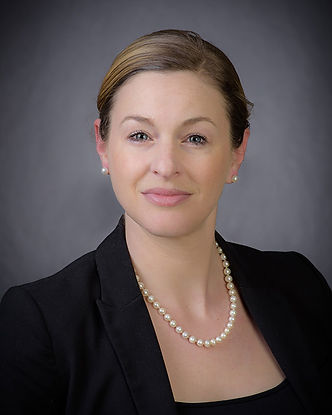


Thomas Graham
Thomas E. Graham is a distinguished fellow at the Council on Foreign Relations. He is a cofounder of Yale University’s Russian, East European, and Eurasian studies program and sits on its faculty steering committee. He is also a research scholar at Yale’s MacMillan Center. He has been a lecturer in global affairs and political science since 2011, teaching courses on U.S.-Russian relations and Russian foreign policy, as well as cybersecurity and counterterrorism. Graham was special assistant to the president and senior director for Russia on the National Security Council staff from 2004 to 2007, during which he managed a White House-Kremlin strategic dialogue. He was director for Russian affairs on the staff from 2002 to 2004. Graham served as an advisor to Kissinger Associates from 2008 to 2021. He was a Foreign Service officer for fourteen years. His assignments included two tours of duty at the U.S. Embassy in Moscow in the late Soviet period and in the middle of the 1990s, during which he served as head of the political internal unit and acting political counselor. Between tours in Moscow, he worked on Russian and Soviet affairs on the policy planning staff at the U.S. Department of State and as a policy assistant in the office of the undersecretary of defense for policy. Graham serves on the advisory board of Russia Matters, a project of the Harvard Kennedy School’s Belfer Center for Science and International Affairs with the goal of enhancing the understanding of Russia among policymakers and the interested public.
Emerging Technology

Edward Wittenstein
Senior Lecturer, Yale Jackson School of Global Affairs
Edward (“Ted”) Wittenstein is a Senior Lecturer in Global Affairs and Director of the Schmidt Program on Artificial Intelligence, Emerging Technologies, and National Power, a signature teaching and research initiative of the Jackson School that examines how AI has the potential to alter fundamental building blocks of world order. A former diplomat and intelligence professional, Ted teaches undergraduate, graduate, and law courses on intelligence, cybersecurity, artificial intelligence, national security decision-making, and the outer space domain. He also serves as Co-Director of the Johnson Center for the Study of American Diplomacy and the Yale Cyber Leadership Forum, as well as a visiting faculty fellow at Yale Law School’s Center for Global Legal Challenges.
Ted is a graduate of Yale College and Yale Law School. Prior to returning to work for Yale, he held a variety of positions at the U.S. Department of Defense, Commission on the Intelligence Capabilities of the United States Regarding Weapons of Mass Destruction, Office of the Director of National Intelligence, and the Department of State.
Lieutenant General John N.T. "Jack" Shanahan (USAF, ret.)
Joint Artificial Intelligence Center, Director, 2018-2020
Lieutenant General John (Jack) N.T. Shanahan, United States Air Force, Retired, concluded a distinguished 36-year military career in 2020. In his final role, he served as the inaugural Director of the U.S. Department of Defense (DoD) Joint Artificial Intelligence Center (JAIC), where he led efforts to integrate AI across the defense enterprise. Over his career, Jack held a variety of operational and staff positions spanning flying operations, intelligence, policy, and command and control. He commanded at the squadron, group, wing, agency, and Numbered Air Force levels. As the founding Director of the Algorithmic Warfare Cross-Functional Team (Project Maven), he pioneered the DoD’s first operational AI program, advancing the use of AI for military operations and intelligence collection and analysis.
Jack earned a Master of International Studies degree from North Carolina State University in 2022 and serves on the NCSU Shelton Leadership Center Board of Advisors. He is an Adjunct Senior Fellow with the Center for a New American Security (CNAS) Technology and National Security Program and a non-resident Senior Fellow with the Institute for America, China, and the Future of Global Affairs (ACF) at the Johns Hopkins School of Advanced International Studies. Additionally, Jack serves on numerous defense- and intelligence-focused committees, boards, and advisory groups and advises on the use of AI for national security.